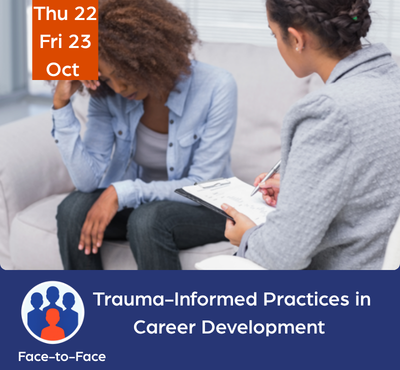
Trauma-Informed Practices in Career Development Conversations and Counselling Sessions
Trauma-informed practice is an essential approach in career development counselling, recognising that past and present life experiences can significantly influence an individual's confidence, motivation, decision-making, and ability to engage in career planning. Career practitioners, advisors, and counsellors use this lens to approach clients with empathy, understanding, and sensitivity, acknowledging that behaviours such as uncertainty, withdrawal, or hesitation may reflect protective responses rather than a lack of interest or commitment.

Rather than treating trauma, trauma-informed practice focuses on creating safe, respectful, and empowering environments where clients feel supported and in control of their own journey. By embedding principles of safety, trust, collaboration, choice, and empowerment into career conversations, practitioners can minimise the risk of harm, strengthen the counselling relationship, and help clients build confidence, recognise their strengths, and move forward in ways that feel achievable. This approach promotes more inclusive, meaningful, and effective career development outcomes for diverse client groups.

Refer to website for further information

31/05/2027 (Australia/Melbourne) - 01/06/2027 (Australia/Melbourne)
$900.00
Register

Already a member? Login here

Member Prices

  • Professional: $700.00
  • Associate: $700.00
  • Standard: $700.00
  • Student: $700.00

Session Information

09:30 AM - 04:00 PM session
Trauma-Informed Practices in Career Development Conversations and Counselling Sessions
👤 Kerry Brookes, RTO Manager, CEAV Institute.
CICA Standards
  • 1b: Apply career development theories, concepts, research, and associated models and frameworks to practice in hybrid, digital and physical environments
  • 3a: Establish and maintain rapport
  • 3b: Communicate effectively across diverse audiences and platforms, adapting your verbal and written approaches to match varying levels of digital literacy and accessibility needs
  • 3c: Work effectively in hybrid team environments, including remote, in-person, and AI-assisted collaboration
  • 3d: Model professional digital interactions to communicate effectively using virtual platforms
  • 4a: Apply the CICA Code of Ethics
  • 4b: Demonstrate commitment to professionalism
  • 4c: Demonstrate commitment to lifelong learning
  • 4d: Apply ethical principles to the use of digital tools
  • 5a: Recognise and respect diversity in all its forms, including digital divide considerations
  • 5b: Conduct career development practice in culturally sensitive ways
  • 5c: Ensure digital resources and platforms are inclusive, accessible, and appropriate for diverse client backgrounds
  • 7a: Conduct needs assessment
  • 7b: Follow case and/or project management procedures
  • 7d: Evaluate the service provided to clients
  • 7e: Where appropriate use digital assessment tools to identify client goals, strengths, barriers, and levels of digital literacy
  • S1: Career assessment - Assess, select, administer, interpret and apply career assessment instruments and processes to inform client understanding and support goal setting
  • S2: Career counselling - Apply advanced career counselling skills to support clients through complex transitions, decision-making processes and change
  • S3: Career development program delivery - Assess the need for, design, deliver and evaluate structured career development programs tailored to specific groups or contexts
  • S4: Diverse clients - Work respectfully and effectively with clients from diverse backgrounds, adapting services to meet cultural, linguistic, social, and individual needs
  • S7: Research skills - Conduct, interpret, and apply research to inform and improve career development practice and policy
APST Standards
  • 6: Teachers use a range of teaching practices and resources to engage students in effective learning
  • 7: Teachers reflect on, evaluate and improve their professional knowledge and practice

09:30 AM - 04:00 PM session
Trauma-Informed Practices in Career Development Conversations and Counselling Sessions
👤 Kerry Brookes, RTO Manager, CEAV Institute.
CICA Standards
  • 1b: Apply career development theories, concepts, research, and associated models and frameworks to practice in hybrid, digital and physical environments
  • 3a: Establish and maintain rapport
  • 3b: Communicate effectively across diverse audiences and platforms, adapting your verbal and written approaches to match varying levels of digital literacy and accessibility needs
  • 3c: Work effectively in hybrid team environments, including remote, in-person, and AI-assisted collaboration
  • 3d: Model professional digital interactions to communicate effectively using virtual platforms
  • 4a: Apply the CICA Code of Ethics
  • 4b: Demonstrate commitment to professionalism
  • 4c: Demonstrate commitment to lifelong learning
  • 4d: Apply ethical principles to the use of digital tools
  • 5a: Recognise and respect diversity in all its forms, including digital divide considerations
  • 5b: Conduct career development practice in culturally sensitive ways
  • 5c: Ensure digital resources and platforms are inclusive, accessible, and appropriate for diverse client backgrounds
  • 7a: Conduct needs assessment
  • 7b: Follow case and/or project management procedures
  • 7d: Evaluate the service provided to clients
  • 7e: Where appropriate use digital assessment tools to identify client goals, strengths, barriers, and levels of digital literacy
  • S1: Career assessment - Assess, select, administer, interpret and apply career assessment instruments and processes to inform client understanding and support goal setting
  • S2: Career counselling - Apply advanced career counselling skills to support clients through complex transitions, decision-making processes and change
  • S3: Career development program delivery - Assess the need for, design, deliver and evaluate structured career development programs tailored to specific groups or contexts
  • S4: Diverse clients - Work respectfully and effectively with clients from diverse backgrounds, adapting services to meet cultural, linguistic, social, and individual needs
  • S7: Research skills - Conduct, interpret, and apply research to inform and improve career development practice and policy
APST Standards
  • 6: Teachers use a range of teaching practices and resources to engage students in effective learning
  • 7: Teachers reflect on, evaluate and improve their professional knowledge and practice

Trending Events


Top